Choosing cooking oils for everyday use
For everyday cooking, choose an oil lower in saturated fat and suitable for the heat you use. Canola, olive, peanut and other unsaturated oils can all have a place in a Singapore kitchen. The type of fat and the amount both matter. Start your comparison with the nutrition label and the cooking instructions on the bottle.
The types of fat in cooking oils
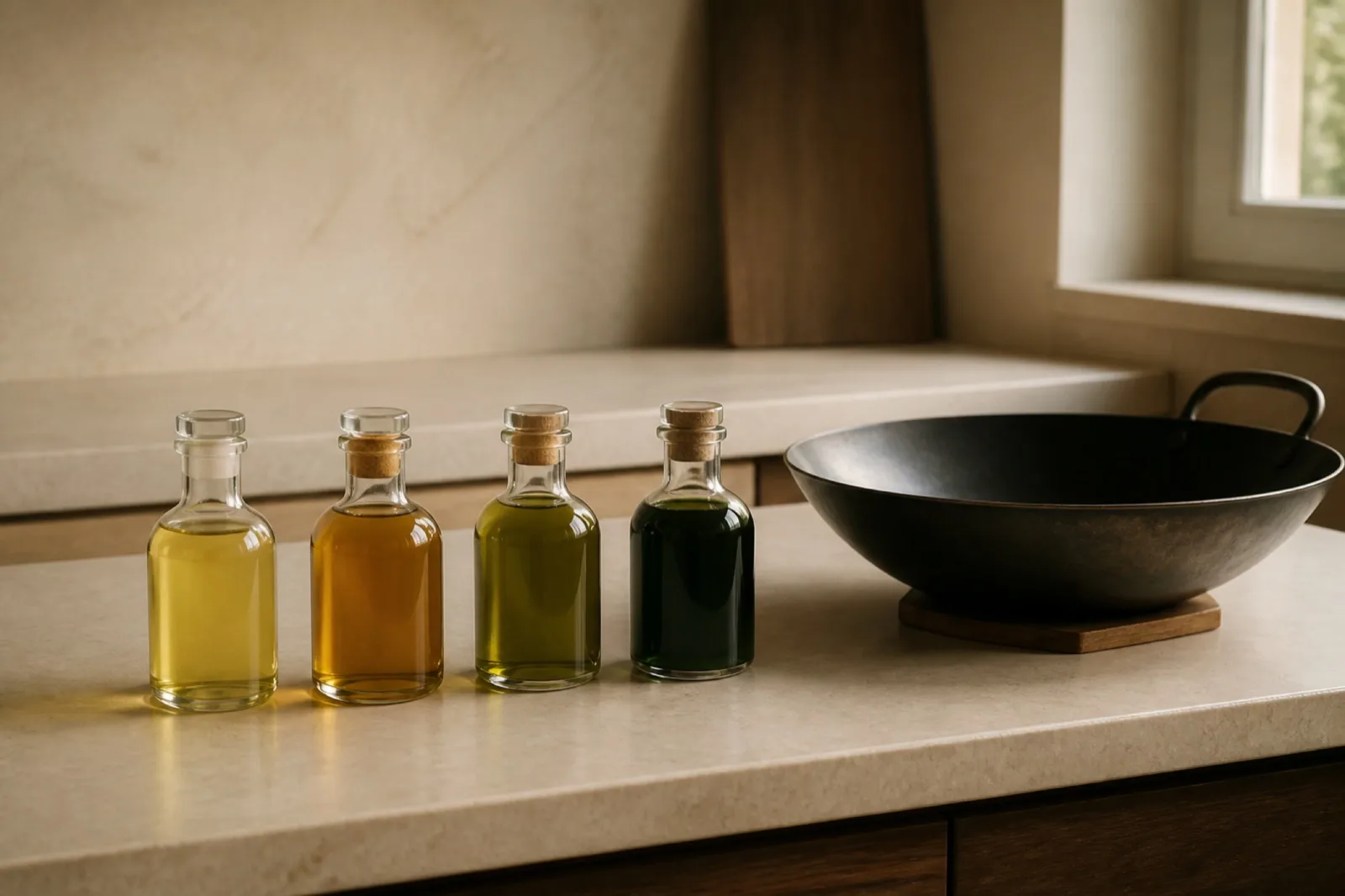
All cooking oils are fat, and all fat is made of the same three families in different proportions.
- Saturated fat occurs in higher amounts in coconut and palm oils, butter, ghee and fatty meat. WHO recommends no more than 10% of total energy from saturated fat. Replacing some saturated fat with unsaturated fat can help lower LDL cholesterol.
- Monounsaturated fat. Olive, peanut and canola oils contain substantial amounts. They are useful options when replacing saturated fats. Suitability for high heat depends on the particular oil and its processing.
- Polyunsaturated fat includes essential omega-6 and omega-3 fats. Soybean, corn and conventional sunflower oils contain omega-6; canola also contains plant omega-3. These fats can be part of a healthy diet. Avoid overheating oils, and avoid long periods of repeated heating.
No oil is a single family. Olive oil, often described as monounsaturated, still contains some saturated fat. Palm oil, often described as saturated, is about half unsaturated.
Trans fats include those once supplied by partially hydrogenated oils. Singapore prohibited partially hydrogenated oils as ingredients in foods from June 2021. Some animal foods can still contain small amounts of natural trans fat; the ban does not mean all foods contain none.
Matching oil to the cooking temperature
Every oil begins to break down at a certain temperature, giving off a bluish smoke and an acrid smell. This is the smoke point. Past it, the oil produces compounds that taste bitter and are best not eaten as a habit.
Refined oils have a higher smoke point than unrefined ones, because refining removes the particles that burn first. Refined peanut, canola, rice bran, sunflower and refined olive oil all cope with the high heat of a wok. Extra virgin olive oil, unrefined sesame oil and unrefined coconut oil have lower smoke points and suit gentler cooking or finishing.
Matching the oil to the method:
- Deep-frying and high-heat stir-frying need a refined oil with a high smoke point and a neutral taste.
- Everyday pan-frying and sautéing at moderate heat suits almost any liquid oil, including olive oil.
- Dressings, dips and drizzling suit extra virgin olive oil, which you use for its flavour and do not need to heat.
- Finishing is where toasted sesame oil belongs. A few drops over a dish at the end gives the aroma without burning it.
Exact smoke points vary by brand and degree of refining. Once an oil starts to smoke, the pan is too hot for that oil.
Common oils and how to use them
Palm oil contains about half saturated fat, and you will find it in some cooking and manufactured foods. Blended oils vary: read the ingredients and nutrition panel instead of assuming that every bottle labelled vegetable oil is palm-based.
- Peanut oil is high in monounsaturated fat, has a high smoke point and a mild nutty taste. It is a good all-round wok oil. Anyone with a peanut allergy should check with their doctor before using it.
- Canola oil is low in saturated fat, high in monounsaturated fat, contains some plant omega-3, and is neutral in flavour with a high smoke point. It is one of the more sensible everyday choices, and most often one of the cheaper bottles.
- Sunflower oil comes in two forms. The ordinary version is high in polyunsaturated omega-6 fat and less stable under repeated heating. The high-oleic version behaves more like canola, and the label states which is in the bottle.
- Olive oil is mostly monounsaturated. Extra virgin is unrefined, flavourful and best used raw or at moderate heat. Refined or "light" olive oil suits higher heat. Both cost more, so many households keep olive oil for dressings and a cheaper oil for the wok.
- Coconut oil is high in saturated fat, more so than palm oil or butter. Claims that it is a health food have not held up in mainstream reviews, and HPB advises limiting it as it does other saturated fats. It remains a fine ingredient for the dishes that need its flavour.
- Sesame oil. Cooks often use toasted sesame oil in small amounts for flavour. You can cook with other sesame oils. Follow the bottle’s intended use rather than treating all sesame oils as the same product.
- Rice bran oil is mild, high in monounsaturated fat and suits high heat, much like peanut oil.
- Ghee and lard contain more saturated fat than many liquid vegetable oils. Use them in small amounts where their flavour matters, and choose lower-saturated-fat oils for most everyday cooking.
Use the nutrition panel to compare saturated fat. Whether an oil is solid or cloudy at room temperature is only a rough clue and depends on temperature and its mixture of fats.
What the Healthier Choice Symbol tells you
HPB's Healthier Choice Symbol appears on cooking oils that meet its criteria for lower saturated fat, in most cases those in the canola, sunflower, peanut, rice bran, olive and blended categories. The symbol is a quick filter in a crowded aisle, and it is most useful for blended oils, where the front label seldom says what is inside.
The symbol has limits. It says the oil is lower in saturated fat than others in its category, and nothing about how much you use: a litre of Healthier Choice oil used for daily deep-frying is still a litre of fat.
Using oil carefully and recognising deterioration
Repeated heating makes oil deteriorate. SFA advises against reusing it too many times and recommends straining out food particles before reuse. Discard oil that develops an unusual colour, smell, foam or smoke at normal cooking temperatures. There is no universal safe number of reuses: temperature, time, storage and the food cooked all matter.
All fats supply about nine kilocalories per gram, so oil is energy-dense whichever type you choose. Measuring it can help control the amount. Fat quality still matters: reducing the quantity does not remove the benefit of choosing unsaturated fats in place of saturated fats.
Some practical ways to use less: measure with a spoon rather than pouring from the bottle, use a non-stick pan for eggs, steam vegetables and add a little oil at the end, and choose a soup or steamed dish at the hawker centre more often than the deep-fried one.
Choosing an everyday oil
For everyday cooking in a Singapore kitchen, a refined oil that is low in saturated fat and copes with the wok is the sensible default, and canola, peanut and rice bran oil all fit. Extra virgin olive oil is worth having for dressings and gentle cooking. Coconut oil, ghee and lard are for the dishes that need their flavour, in small amounts.
Choose both an appropriate oil and an appropriate quantity. The Healthier Choice Symbol can help identify lower-saturated-fat options within a category, and the nutrition panel lets you compare them side by side. Follow your individual dietary plan if you are managing a medical condition.
A practical next step
Compare saturated fat on the label, choose an oil suited to your cooking method, and measure it rather than pouring from the bottle. Stop heating oil if it smokes, and discard oil that has deteriorated.
Sources and further reading
These references explain the guidance and research discussed above. For advice about your own health, speak to a qualified healthcare professional.
Read next
Water: how much to drink in Singapore's climate
There is no single number, but there are three reliable signals
Stress: what it does to the body, and what helps day to day
A plain account of the stress response