The Mediterranean diet with Singapore food
You can follow the main principles of a Mediterranean diet with food available in Singapore. Eat plenty of vegetables, beans, fruit and whole grains, use unsaturated oils for most of your cooking, and choose fish more often than red or processed meat. The pattern is flexible enough for home cooking and hawker meals; it does not require a different cuisine.
What is the Mediterranean diet?
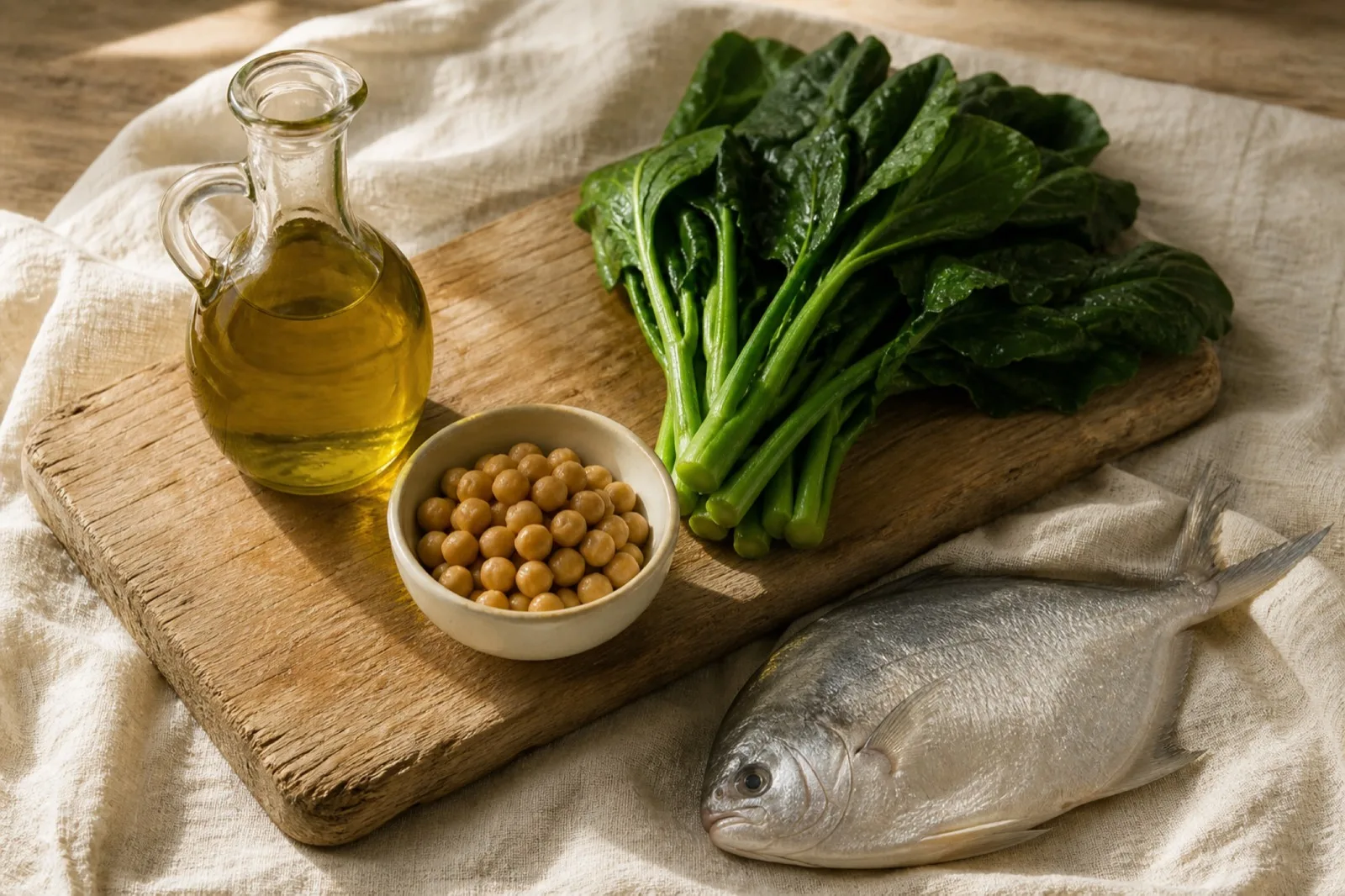
The Mediterranean diet describes the traditional eating patterns of parts of the Mediterranean region, including Greece and southern Italy. There is no single menu: researchers describe shared features such as frequent vegetables, legumes, whole grains and olive oil, with less red and processed meat.
The pattern has a few consistent features.
- Vegetables, fruit, legumes and whole grains form the bulk of every meal.
- Olive oil is the main fat, used for cooking and dressing, in place of butter and lard.
- Fish and seafood appear a few times a week.
- Poultry, eggs and dairy appear in moderate amounts, with yoghurt and cheese more common than milk.
- Red meat and sweets are occasional foods, eaten in small amounts.
- Nuts and seeds are a regular snack.
- Water is a suitable everyday drink. Some historical descriptions include wine, but you do not need alcohol for the benefits of this eating pattern and should not start drinking for health reasons.
People also take their time over meals and most often eat with others. Researchers count that as part of the pattern, because it is hard to separate from the food.
What does the research show?
Researchers have studied Mediterranean dietary patterns for decades, through both observational studies and trials. This provides a stronger evidence base than a diet supported only by testimonials, although the results depend on the population and the version of the diet studied.
The findings are consistent. People who stick to the pattern have lower rates of heart disease and stroke on average, better cholesterol and blood pressure numbers, and lower rates of type 2 diabetes. Several trials have shown that switching to the pattern lowers the risk of heart events in people who were already at high risk. That is stronger evidence than most diets have, because it comes from people being assigned to the diet rather than choosing it.
Studies examine an overall dietary pattern. Adding olive oil alone is not equivalent to adopting that pattern. The evidence supports its use in the populations studied. You can apply shared nutritional principles to local meals, but no one has proved that every substitution has an identical effect.
That reasoning is sound, because the elements of the pattern that matter are the ones HPB and WHO already recommend: more vegetables and legumes, unsaturated fat in place of saturated, whole grains in place of refined, fish in place of red meat, and less sugar.
Local foods that fit the pattern
You can use these familiar foods to apply the main principles to local cooking and hawker orders.
- Olive oil and other unsaturated oils. Olive oil is central to the traditional pattern. Canola, sunflower and peanut oils can be practical alternatives when you replace saturated fats in local cooking, although you should not assume they reproduce every finding from olive-oil trials.
- Legumes become dhal, chickpeas, tofu and tempeh. The Mediterranean plate leans on lentils, chickpeas and beans. Singapore already has dhal at Indian stalls, tau kwa and tempeh at wet markets, and chickpeas in tins.
- Whole grains become brown rice, wholemeal chapati and oats. Wholegrain bread and pasta are the Mediterranean version. Brown rice at cai png, wholemeal bread at breakfast and oats a few mornings a week do the same work.
- Fish becomes fish soup, steamed fish and ikan bakar. Grilled and stewed fish is central to the pattern. Sliced fish soup, steamed sea bass, sardines and ikan bakar without a heavy sambal are all direct equivalents, but deep-fried fish in batter is not.
- Vegetables and fruit. Kai lan, chye sim, spinach, long beans and bittergourd all fit. Singapore’s My Healthy Plate sets aside half the plate for vegetables and fruit together, a quarter for whole grains and a quarter for protein.
- Nuts become unsalted peanuts, almonds and cashews. A small handful is the portion.
- Yoghurt and cheese become plain yoghurt and paneer, in moderation. Dairy is a modest part of the pattern.
- Fruit becomes papaya, guava, banana and whatever is in season. Fruit is the usual dessert.
A sample day of meals
A day that follows the pattern in Singapore does not need to look Mediterranean.
Breakfast might be oats with banana and a few nuts, or wholemeal toast with an egg and a tomato. Kopi or teh with less sugar goes with it.
Lunch at the hawker centre might be sliced fish soup with brown rice and extra vegetables, or an Indian vegetarian plate of dhal, two vegetable curries and chapati, or cai png with tofu, two greens and a small portion of fish. Water or teh kosong is the drink.
Dinner at home might be steamed fish with ginger and spring onion, stir-fried kai lan in a little oil, and brown rice. On another night it might be a pot of chickpea curry with a wholemeal chapati.
Red meat, in this pattern, appears a few times a month rather than a few times a week. A char siew rice or a mutton curry is not banned, and you can keep it as an occasional meal instead of the default.
Snacks are fruit or a handful of unsalted nuts. Sweet drinks, kueh and pastries move to the same occasional column as red meat.
Across the week, the aim is more vegetables, legumes and whole grains, most of your fat from unsaturated sources, and less red or processed meat and free sugar. Choose ingredients and portions that suit your budget and household; imported Mediterranean foods are optional.
Simple changes to start with
The Mediterranean diet is one of the best-supported ways of eating, and its components line up with what HPB recommends for Singapore. There is no need to buy imported ingredients or cook a different cuisine. The pattern is about proportions and choices, and every choice has a local version.
The sensible way to start is one element at a time. Switch the everyday cooking oil to an unsaturated one. Add legumes to two or three meals a week. Choose fish over red meat more often. Move to brown rice or wholemeal bread where it is available. Keep sweet drinks for occasions. Those five changes cover most of the pattern.
Anyone with a diagnosed condition, in particular heart disease, diabetes or kidney disease, should talk to their doctor or dietitian before making a large change to how they eat. The pattern is compatible with most treatment plans, but it is worth checking, and no one should adjust a medication on the strength of a diet change.
A practical next step
Try one change you can keep: add dhal or tofu to more meals, choose brown rice, or replace a saturated cooking fat with an unsaturated oil. Keep portions and the overall balance of the meal in mind.
Sources and further reading
These references explain the guidance and research discussed above. For advice about your own health, speak to a qualified healthcare professional.
Read next
The different types of vegetarian diet, explained
From lacto-ovo to Jain
Intermittent fasting: the patterns, and who should not try it
The three common patterns